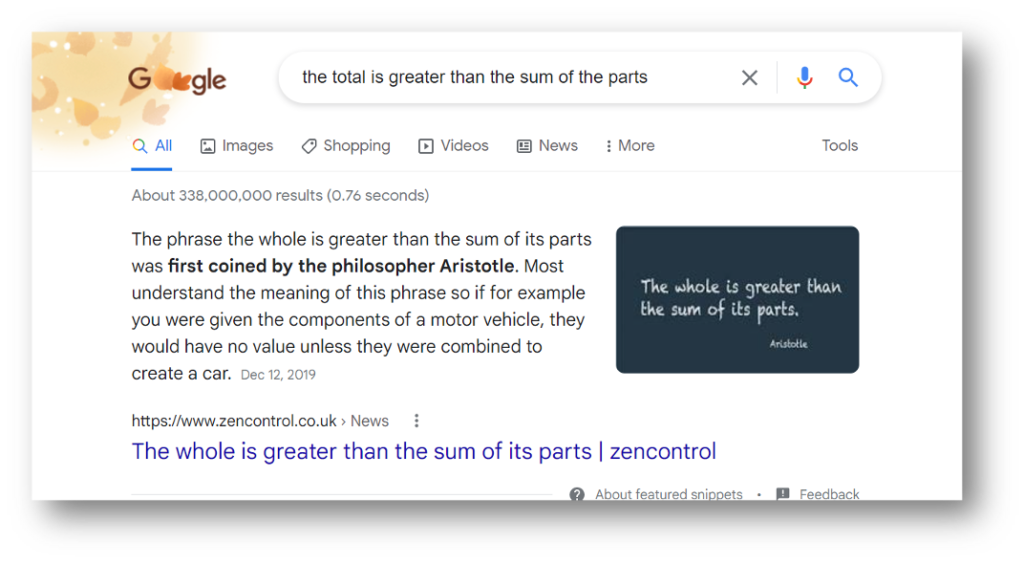
One of any chimera’s favorite quotations, (you can probably guess why) is “The whole is greater than the sum of its parts.” This phrase is usually attributed to Aristotle. A quick post today to delve into the saying more deeply…
The phrase is fundamental to Gestalt psychology and often said to have originated with famous Gestalt psychologist Kurt Koffka[1]—albeit as, “the whole is other than the sum of its parts.” It turns out that the quote attributed to Koffka is actually closer to the original Aristotelean:
In the case of all things which have several parts and in which the totality is not, as it were, a mere heap, but the whole is something besides the parts, there is a cause.[2]
An alternative translation I found only emphasizes the point:
“In all things which have a plurality of parts, and which are not a total aggregate but a whole of some sort distinct from the parts, there is some cause.”[3]
In the second translation we have parts that are “distinct” from the whole rather than “besides” it. By the way, it is unlikely someone erroneously mistranslated Aristotle as saying greater. For example: The word greater would not be hard to spot if it had been there. In ancient Greek it’s meǵhlos. It the word we get our “mega” from. It’s megalýteri in modern Greek. Both authoritative translations get away from the ‘sum’ so common in the quoted phrase, which is good, because ‘sum’ evokes maths and Euclid.
Indeed, “…the sum of” is is found in Euclid’s famous Elements, published around 300BC as one of his four “Common Notions” (CNs):
1. Things which equal the same thing also equal one another.
2. If equals are added to equals, then the wholes are equal.
3. If equals are subtracted from equals, then the remainders are equal.
4. Things which coincide with one another equal one another.
5. The whole is greater than the part[4].
CN #5, “the whole is greater than the part,” could be interpreted as a definition of ‘greater than’: “To say one magnitude B is a part of another A could be taken as saying that A is the sum of B and C for some third magnitude C, the remainder.”[5] It can be presumed that Aristotle’s concern with these words was not the same as Euclid’s.
Apparently the CNs weren’t included in the original publication. Furthermore, it is stated that “Christopher Clavius (1538–1612) added the axiom that the whole is the equal to the sum of its parts.” This axiom does not conflict with the idea that the parts are other than the whole. However, in Book VI of Aristotle’s Topics, the author says in chapter 13:
“… that the whole is not the same as the sum of its parts are useful in meeting the type just described; for a man who defines in this way seems to assert that the parts are the same as the whole. The arguments are particularly appropriate in cases where the process of putting the parts together is obvious, as in a house and other things of that sort: for there, clearly, you may have the parts and yet not have the whole, so that parts and whole cannot be the same.”[6]
To sum up (ouch!), we have to conclude that Aristotle did not say the whole is greater than the sum of its parts. Greater and sum of are particularly problematic when one considers the actual translation we have just uncovered: “The whole is something besides the parts.”
Laters!
–MC.
References
[1] https://www.psywww.com/intropsych/ch04-senses/gestalt-psychology.html
[2] https://se-scholar.com/se-blog/2017/6/23/who-said-the-whole-is-greater-than-the-sum-of-the-parts
[3] Aristotle. Aristotle in 23 Volumes, Vols.17, 18, translated by Hugh Tredennick. Cambridge, MA, Harvard University Press; London, William Heinemann Ltd. 1933, 1989. Retrieved September 22, 2021 from http://www.perseus.tufts.edu/hopper/text?doc=Perseus%3Atext%3A1999.01.0052%3Abook%3D8%3Asection%3D1045a
[4] https://mathcs.clarku.edu/~djoyce/elements/bookI/cn.html
[5] Ibid.
[6] Aristotle 100a, Topics, Translated by W. D. Ross Retrieved on September 22, 2021 from https://se-scholar.com/se-blog/2017/6/23/who-said-the-whole-is-greater-than-the-sum-of-the-parts
I was very pleased to find this site. I wanted to thank you for your time for this particularly wonderful read!! I definitely savored every little bit of it and i also have you book-marked to see new stuff in your site.
עיסוי בשרון | … לוי מעניקה טיפולי שיאצו, עיסוי
שוודי, עיסוי הוליסטי, רקמות עמוק וטווינה, על פי הצורך.
בין הטיפולים שאפשר יהיה לקבל : עיסוי שוודי, עיסוי רקמות עמוק, עיסוי תאילנדי, רפלקסולוגיה, טיפולי אבנים חמות.
ספא בכפר סבא יעניק לכם את
כל מבוקשכם: מגוון רחב של טיפולי גוף ועיסויים:
עיסוי שבדי, רקמות עמוק, רפלקסולוגיה, פילינג גוף ועוד.
כל עיסוי שמגיע לביתכם יעניק לכם את
העיסוי האולטימטיבי והאיכותי ביותר
בו תרגישו נח, כשאתם נשארים למעשה בין כתלי הבית שלכם.
ספא בכפר סבא יעניק לכם מגוון רחב של טיפולי גוף ועיסויים כמו
עיסוי שבדי, רקמות עמוק, רפלקסולוגיה,
פילינג גוף ועוד. שבו שלל סוגי טיפולים מידיהם המסורות של מטפלים ומטפלות מנוסים, כמו אבנים
חמות, שיאצו, אירוודה, עיסוי רפואי, רפלקסולוגיה, פילינג
גוף, טיפול לספורטאים וגם טיפול לנשים הרות.
מנטרה ספא הינו ספא ייחודי שבו שלל סוגי טיפולים עם מטפלים ומטפלות מנוסים, מהטובים בתחומם.
בצידו הימני של הדף תוכלו ללמוד
על סוגי הטיפולים השונים אותם המטפלים באתר מציעים לכם במגוון עשיר של עיסויים מקצועיים החל מעיסוי
שוודי מפנק ועד עיסוי רקמות עמוק לשרירים תפוסים במיוחד..
מכשירי עיסוי מבית אמריקן קומפורט, פשוטים ונוחים לשימוש, מומלצים לטיפול בשרירים תפוסים בכל הגוף, לטיפול בכאבים ריאומטיים, להמרצת מחזור הדם, לטיפול
בגב תפוס, ולשיפור ההרגשה הכללית.
במנטרה ספא נזכה לטיפול מסור,כאשר באפשרותנו לבחור בין החבילות המפנקות השונות.
Feel free too surf to my webb page; https://exoticsenualoriental.com/categor/Discreet-apartments-in-Ramat-Gan.php
https://shorturl.fm/6EbZM
https://shorturl.fm/z9aQO
https://shorturl.fm/BTd2J
https://shorturl.fm/pCqLi
https://shorturl.fm/fNfWr
https://shorturl.fm/1ovy9
Finally a place to download the 1xbet app that doesn’t feel like a scam! 1xbetapkdownload straight up delivers. No BS, just the goods. Appreciate it! Here’s where you can dl it from 1xbetapkdownload!
If you are looking for a place to login, this is the place to use. No waiting time for me to get in like other platforms. You can explore by pressing this link okttlogin!
Casino7cslot is honestly my go-to for slots. Great selection, and I’ve actually won a decent amount. Worth checking out if you’re into online casinos. Go give it a try here casino7cslot!
https://shorturl.fm/H8EsD
https://shorturl.fm/EFXQq
https://shorturl.fm/fBWI2
https://shorturl.fm/IHtCi
https://shorturl.fm/CWuAp
https://shorturl.fm/Y4GKZ
https://shorturl.fm/E1kPg
https://shorturl.fm/VfvnY
https://shorturl.fm/a1DQu
https://shorturl.fm/eAv0d
https://shorturl.fm/beYCo
https://shorturl.fm/n4UOH
https://shorturl.fm/HflYS
Downloaded the g55betapp the other day. Pretty simple to use. If you are in the market for such an app, then give this a try, then you might find your home there! You can check them out on g55betapp.
Hey everyone, just saw g55betcom. I think the website loads quick. I am not sure what else I can tell, I think the best if that you check it yourserlf. Visit them at g55betcom.
I used g55betlogin earlier today. I experienced some minor trouble getting logged in, no promises. It looks interesting I think! What do you think? g55betlogin.
https://shorturl.fm/8tabg
jra6xi
https://shorturl.fm/ymQkX
ffupcw
https://shorturl.fm/RFFGF
https://shorturl.fm/zoNZR
https://shorturl.fm/tH7Ua
https://shorturl.fm/WtHrY
https://shorturl.fm/gVXB0
https://shorturl.fm/MTDOp
https://shorturl.fm/YRdwb
totnw4
https://shorturl.fm/0PtUv
https://shorturl.fm/t7Nbn
https://shorturl.fm/m7zLa
qdl3ac
https://shorturl.fm/b78Y1
https://shorturl.fm/ZQzEw
Alright, alright, pt888vip, I see you. Took a spin, and not gonna lie, had some fun. Smooth sailing for a bit, ya know? Check it out for yourself: pt888vip
Hey, dipped my toes into m8win55. Interface is pretty chill and games are decent. Worth a shot if you’re looking for something new. Give it a go: m8win55
Was messing around on dr88us the other night. Won some lost some that is the way she goes. Solid enough platform. Have a look: dr88us