“As the trees move in, silence falls across the land. No birds sing, no bees buzz, no flowers bloom.”
– Mary Cowell
Around the world are efforts by leaders and volunteers alike to plant trillions of trees to help stave off the climate crisis. Indeed, the World Economic Forum has pledged to grow, restore, and conserve 1 trillion trees. Many countries have their own national tree-planting incentive programs, with the goal to plant millions of trees so they can capture carbon before it releases into the Earth’s atmosphere.
In Turkey just two years ago (November 2019) President Recep Tayyip Erdoğan watched on as volunteers planted 11 million trees in a vision called “Breath for the Future.” Erdoğan summoned the Guinness Book of World Records (a penchant of his) to certify the biggest mass tree planting: 303,150 trees in one hour. Less than three months later, 90% of the saplings were dead.
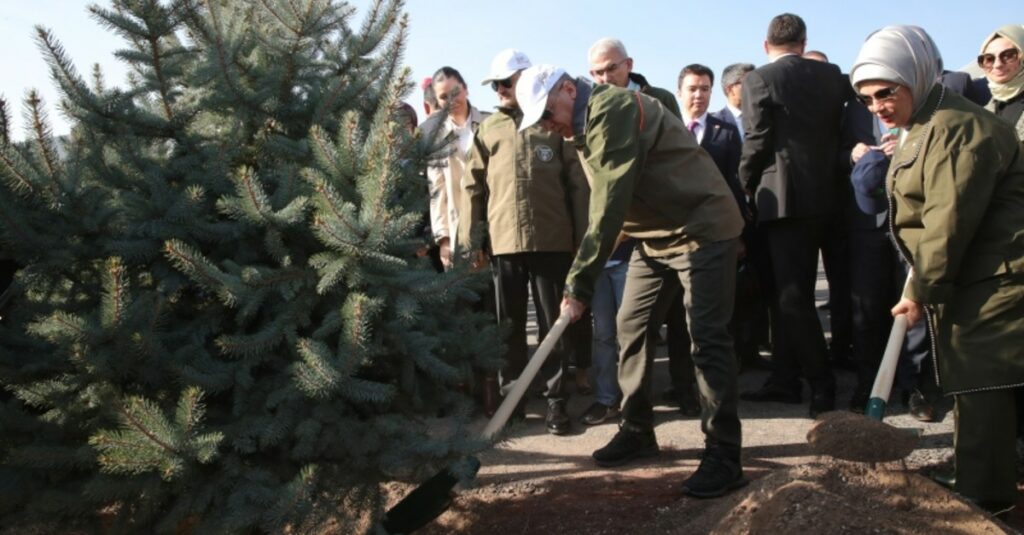
Planting at the wrong time of year with the wrong kind of tree and the lack of necessary follow-up care for tender, young saplings probably kills more tree-planting initiatives than anything else. Experts state that it takes three years of monitoring for a reforestation project. After three years the fastest growing trees are mature. For many it takes up to 8 years.
Why take all this effort? The majority of the world’s electricity is still created from fossil fuels; the greatest emitter of carbon in the entire energy sector is generating that power. Power generated from fossil fuels has increased by 70% since 2000. In a report, Penn State explains,
“Trees are without a doubt the best carbon capture technology in the world. When they perform photosynthesis, they pull carbon dioxide out of the air, bind it up in sugar, and release oxygen. Trees use sugar to build wood, branches, and roots. Wood is an incredible carbon sink because it is made entirely of carbon, it lasts for years as a standing tree, and takes years to break down after the tree dies.”
So what’s the problem? It seems like tree-planting is a definite winning strategy if we time it correctly and take care of them, right? There are actually multiple problems. First, it’s actually not the case that “without a doubt” trees are the best carbon capture technology in the world! Undisturbed peatlands, for example, can actually store far more carbon beneath the earth than trees. Yet all over the planet peatlands, grasslands, and other valuable ecologies are being ripped up to make way for “carbon capturing trees.”
Much land being cultivated for tree-planting programs would serve the environment better if it were simply re-wilded to its original state rather than ripped up for trees not suited for the environment or the populace.
A second issue is that saplings need adequate irrigation. If there is not enough rainfall to support these young trees, some other arrangement must be made for the plantings to be watered. One wonders if all the governments from the Cop26 summit have taken this into account. Boris Johnson, Britain’s prime minister and full time orangutan wearing a busted straw hat, had this to say: “These great teaming ecosystems—these cathedrals of nature—are the lungs of our planet.” Eloquent.
At Cop26, the UAE, which is one of the largest producers of oil in the worlds, has pledged to plant 100m mangroves by 2030; India wants to cover a third of its land in forest. Surely trees can save us! Unfortunately, there isn’t actually enough land on this planet to use trees’ carbon capturing capability as a primary strategy for combatting the vast amount of carbon pollutants we are spewing into the atmosphere.
Planting trees is noble, useful, and an aid in plans to combat the climate crisis. But they are not the answer. At the beginning of Cop26, more than 100 countries pledged to halt and reverse deforestation by 2030. However, to reach net zero using trees and other land-based carbon abatement methods “would require at least 1.6bn hectares of new forests, equivalent to five times the size of India or more than all the farmland on the planet”, a recent study by Oxfam concluded. 1bn hectares is the size of Australia and Brazil combined. Tree planting, even if it is done well and with care for the saplings, is simply not the way to solve our mess.
Then there is the issue of the suitability of the tree species. One tree commonly planted for its ability to grow quickly is the Sitka Spruce, which is the largest of the 35 species of spruce and can grow to a dizzying 300 feet or more. Indeed, it is one of five trees that can reach such heights. It’s little wonder then that mass plantings can disturb native environments if they are planted where they don’t belong.
Native to America’s grand Pacific Northwest, Sitkas make for odd and rather disconcerting blots on Ireland’s gentle landscape. As columnist Darragh Murphy writes, “Ever wondered why many hillside woods in Ireland look out of place? It’s because they are.” Murphy continues:
The Sitka spruce has been planted with semi-religious zeal here since 1907, mainly due to the promptings of one man. Augustine Henry, the Scots-Irish mandarin famous for the aphorism “no forestry without a profit”, saw in Sitka spruce the solution to Ireland’s “useless land”. And the Gospel according to St Augustine continues to hold a quasi-mystical sway over official policy at the Department of Agriculture.
Sitka spruce is said to grow very well in Ireland’s climate. Although it’s worth noting that Farrelly et al. state that such a fact is unknown:
Despite the widespread use of the species in Irish forestry, little is known about the growth potential of Sitka spruce and the nature of relationships between its productivity and site quality variables (climate, soil moisture, and soil nutrients) in Ireland, and no methods exist with which to objectively determine the potential productivity of the species on nonforested sites
Regardless of growth potential, the result is dense, dark, foreboding forests. Much more sinister, local wildlife can’t make habitat in the forests due to Sitka’s unfavorably acidic needles which drop to the ground. They block light. Worse, some animals and birds—like the hen harrier—are being driven to extinction. Nature writer Mary Colwell explains:
More than half of the six sites designated as special protection areas (SPAs) for hen harriers are now planted in Sitka. … Sitka spruce plantations, hectare upon hectare of them, now cover what was once nature-rich farmland. Dense blocks of these non-native coniferous trees smother the landscape, driving out wonderful and endangered wildlife …. To stand in one of the few remaining [hen harrier] nesting sites is to feel like a character in a Hollywood movie where someone is trapped in a room as the walls slowly move inwards. No light penetrates to the floor and no flowers grow.
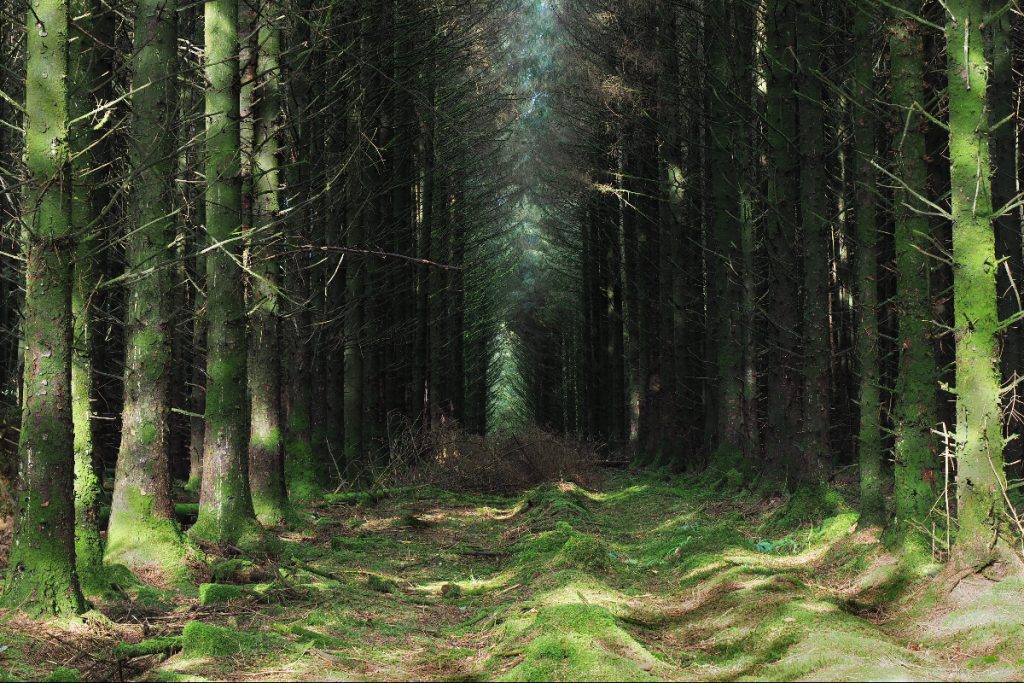
Planting non-native trees on farmland already primed to store carbon can be bad for wildlife and locals.
Irish farmer Jim McCaffrey has battled against forestry plantations three times near his land in Leitrim. He has lost each time. McCaffrey, a suckler farmer, is the fourth generation of his family to work the 23-acre holding at Adoon near Cloone village. He explains that in his opposition, he is considering future generations: his son and grandchild also live on the land. McCaffrey explains,
“The trees affect your light and your view and you lose connectivity. I can no longer see rolling hills or my neighbour working on his fields…. There was a time when I could see the road to Cloone from my patio door. I could tell my children when the school bus was coming. You can’t see that road anymore.”
McCaffrey maintains that large-scale plantations of Sitka spruce have nothing to do with alleviating the impact of climate change: “It’s all about money, money, money and it is taxpayers’ money, which is supporting these investors,” he said.
The group McCaffrey is involved with—Save Letrim—believes that those planting the trees do not live locally. This disputes the survey findings from the Department of Agriculture, which found that 70 per cent of the county’s forest owners were county residents. L
Less than 11% of the country’s land is populated by indigenous trees. A lot of carbon is stored in the soils of peatland and marginal grassland. If they are disturbed, however, by ploughing, draining, tree planting and felling, they can release more carbon into the atmosphere than will be sequestered by the trees.
But the Sitka plantings are about cash as much as anything, as McCaffrey notes. Subsidized Sitka plantations cover vast tracts of Irish countryside. They don’t necessarily offset carbon emissions, are driving bird species to extinction, and provide a host of problems compared to native coniferous woodland. But a Sitka plantation will guarantee a return within a few decades, and they attract silent investors, often from overseas.
Many farmers sell their family farms to these private companies and move out of the area. (Perhaps this is the source of the Dept. of Agriculture survey discrepancy.) Sitkas are quite the headache for many. As Darragh Murphy writes,
Unlike broadleaf woodlands, Irish Sitka spruce monocultures require fertilisers and pesticides. Their “harvesting” also creates quite a mess. In England, foresters artfully coppice hardwoods such as oak, hazel, chestnut and ash in rotation, felling them while still young enough to regenerate multiple trunks, prolonging their life and sequestering more carbon. Here, Sitka plantations are “clear-felled” over vast areas at a time, generating acid sulphate, affecting waterways, and leaving whole hillsides scarred for up to two years.
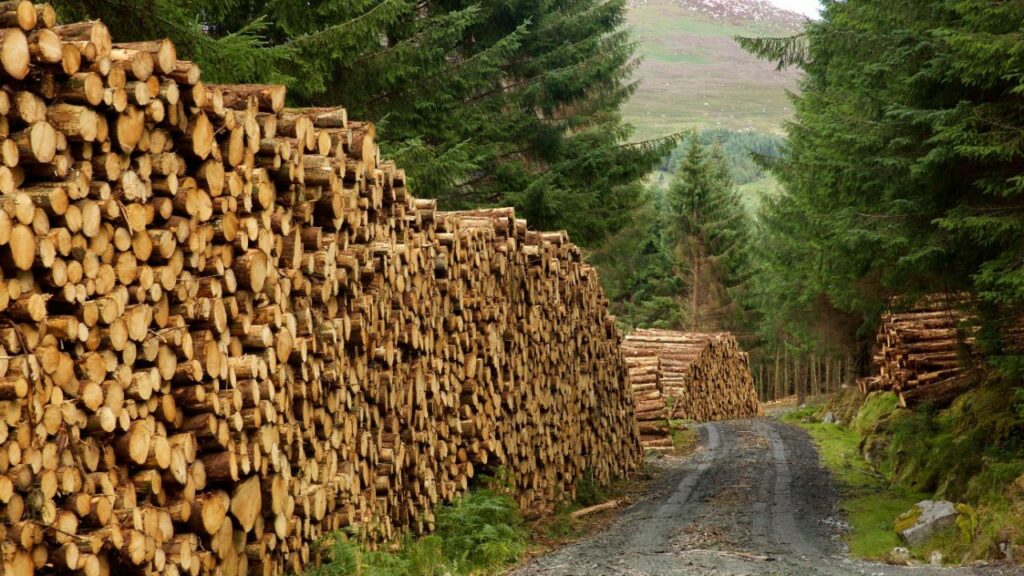
The dual pressures to both grow the economy through dairy and to reduce carbon emissions to meet climate change targets means Sitka spruce continues to dot the land. Ireland is failing to meet its EU targets, and that means more Sitka, more’s the pity: As Cowell says, “Ireland’s rich, natural heritage, as treasured as any traditional music or literature, is being swept aside because it is not considered as valuable as fast-buck plantations.”
A different approach was taken in Norway. Despite varying results from observational studies, in 2012 the Norwegian Biodiversity Information Centre blacklisted Sitka spruce after a risk evaluation for biodiversity in Norway. As a precaution Sitka was classified as having “severe impact,” emphasizing possible negative ecological effects—particularly its potential threats to heathland revert.
A similar conclusion to the one in 2012 was drawn again in 2018. Sitka spruce has been, and will continue to be, the dominant timber species in outer coastal sites in Norway and consequently will account for most of the harvesting output during the next decades.
However, the future of Sitka is highly influenced by the prevailing land management practice. Over the last 30 years, the political emphasis has been on restoring heathland, which is prioritized as a landscape type and its restoration the main goal in management plans for such areas involving clearing forests, especially of non-native tree species.
Norway seems to have taken a sensible approach, but worldwide, tree planting projects are flawed, threatening local ecology or providing easy paths to corruption. In Mexico, some farmers are paid for the trees they plant, so they cut down existing mature trees in order to plant saplings and make money!
Environmental researcher Forrest Fleischman, a co-author on a major study in reforestation published in the journal Nature, reports that in India, an analysis of satellite imagery as well as interviews with thousands of residents showed that decades of government tree planting—hundreds of millions of seedlings—had almost no impact on forest canopy.
Further, “The researchers also measured a shift in the type of trees within the ecosystem, away from species that locals prefer for firewood and animal fodder. In other words, residents of Himachal Pradesh actually had fewer useful forest resources,” reporter Benji Jones writes.
Many experts agree: planting new trees isn’t the answer to carbon capture—restoring natural ecology is. When Penn State said that trees were our greatest carbon capture ally, they were not referring to restricting planet-saving measures to tree-planting projects. Nothing will change as long as land owners are being paid to plant oppressive Sitka forests, or to rip up existing tree-covered farmland. In fact when peatland, for example, is ploughed, or prepared for tree planting it can release even more carbon into the atmosphere.
What can we do? Governments should offer remuneration for proper restoration projects. (Your local version of han herriers will appreciate it.) There isn’t anything sinister about tree-planting when the money is taken out of the equation.
Just look at the World Economic Forum’s 1t.org project, in which stakeholders have agreed to plant trees that total 1 trillion. “Nature-based solutions – locking-up carbon in the world’s forests, grasslands and wetlands – can provide up to one-third of the emissions reductions required by 2030 to meet the Paris Agreement targets,” the Forum said.
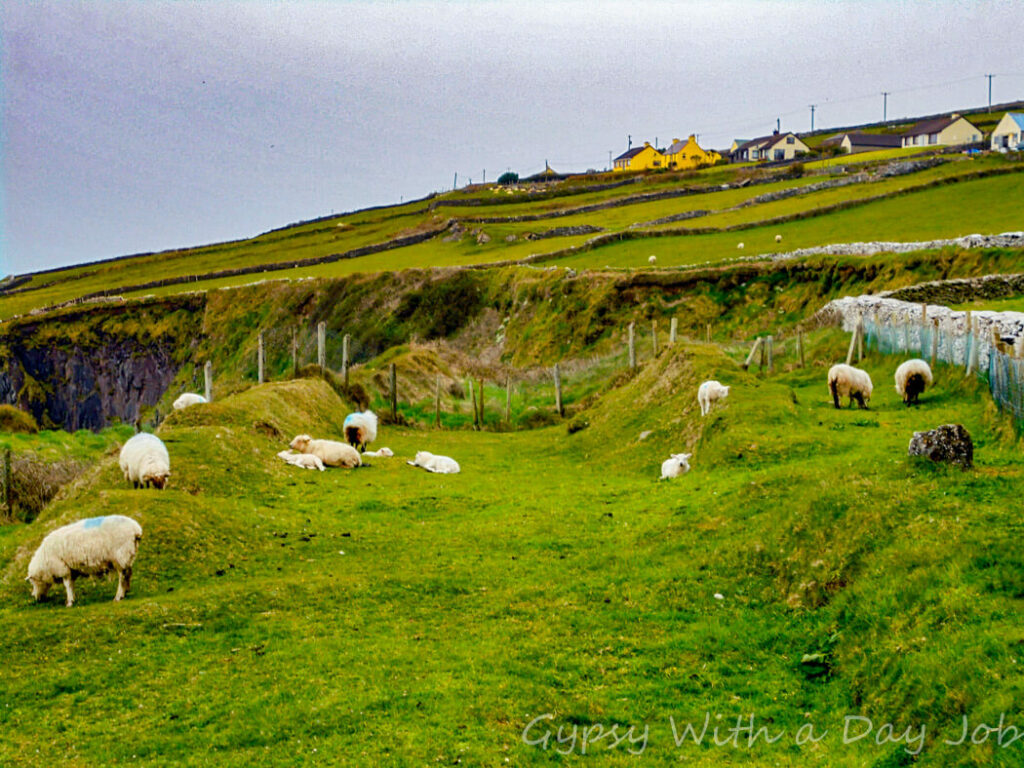
Autobiographically, I grew up primarily on grassland next to moors. There weren’t any woods or forests close by. But the woods I pattered about while living in Europe contained filtered light from beech trees. There were oaks and elms, birches and aspens, and other coniferous trees whose lost leaves in autumn made for fantastic crunching underfoot, as squirrels dashed about with other animals, and birds sang to mark their territory all day long.
The first time I went in a Pacific Northwest forest, featuring Sitka, other spruces, pines, and firs, I walked into deafening silence. Ferns and tree stumps covered the ground save where the trail was. I felt like I was in a movie in which something terrible was going to happen. It was spooky. I had never seen such tall, dense trees like these, certainly not where I lived in California. It was so dark and seemed aseptic bar abundant lichen, moss and fungi.
Now I live next to such a forest in Oregon, and I walk in it at least once a day with my dogs. Age and familiarity have me accustomed to these beautiful clusters of trees. Although, I do miss seeing flowers on the forest floor and wildlife zipping by. I’ve seen elk here, but that is different, and also not common.
I believe that we should re-wild as much as possible. The rolling hills of the Emerald Isle deserve better. Even if it’s more costly, using native, or at least appropriate, species—where they are needed, not splattered willy-nilly over the countryside—is obviously the better strategy if our goal really is carbon capture. How to get the entire world to try to restore the natural ecology? Hopefully the WEC will get on board and add different initiatives from 1t.org. This message needs to get out, and it needs to get out now.
Sources
Coleman, E. A., Schultz, B., Ramprasad, V., Fischer, H., Rana, P., Filippi, A. M., Güneralp, B., Ma, A., Rodriguez Solorzano, C., Guleria, V., Rana, R., & Fleischman, F. (2021). Limited effects of tree planting on forest canopy cover and rural livelihoods in Northern India. Nature Sustainability. https://doi.org/10.1038/s41893-021-00761-z
Colwell, M. (2018, October 10). A Forestry Boom is turning Ireland into an ecological dead zone. The Guardian. https://www.theguardian.com/commentisfree/2018/oct/10/trees-ireland-biodiversity-sitka-birds-extinctio
Farrelly, N., Ní Dhubháin, Á., & Nieuwenhuis, M. (2011). Site index of Sitka spruce (Picea sitchensis) in relation to different measures of site quality in Ireland. Canadian Journal of Forest Research Revue Canadienne de Recherche Forestière., 41(2), 265–278. https://doi.org/10.1139/X10-20
Guinness Book of World Records (n.d.). Retrieved September 30, 2020, from https://www.guinnessworldrecords.com/world-records/most-trees-planted-simultaneously?fb_comment_id=732983423461511_843856505707535
Jones, B. (2021, September 22). The surprising downsides to planting trees. Vox. https://www.vox.com/down-to-earth/22679378/tree-planting-forest-restoration-climate-solutions
Kreye, M. (2020, September 24). How forests store carbon. Penn State Extension. https://extension.psu.edu/how-forests-store-carbon
McDonagh, M. (2020, September 23). Sitka spruce plantations ‘affect your mental health’. Irish Times. https://www.irishtimes.com/news/environment/sitka-spruce-plantations-affect-your-mental-health-leitrim-farmer-1.4361777
Murphy, D. (2018, June 19). Ireland’s native woodlands are quietly disappearing. The Irish Times. https://www.irishtimes.com/culture/heritage/ireland-s-native-woodlands-are-quietly-disappearing-1.3529317
Øyen, B.-H., & Nygaard, P. H. (2020). Impact of Sitka spruce on biodiversity in NW Europe with a special focus on Norway – evidence, perceptions and regulations. Scandinavian Journal of Forest Research, 35(3-4), 117–133. https://doi.org/10.1080/02827581.2020.174870
Pomeroy, R. (2020, January 22). One trillion trees—World Economic Forum launches plan to help nature and the climate. World Economic Forum. https://www.weforum.org/agenda/2020/01/one-trillion-trees-world-economic-forum-launches-plan-to-help-nature-and-the-climate/
I was very pleased to find this site. I wanted to thank you for your time for this particularly wonderful read!! I definitely savored every little bit of it and i also have you book-marked to see new stuff in your site.
mfkkyvfstuxxxoqwghutzquzdvflyd
fhdmpotzwkjdholzlzyjlfqrjmgzfp
rwkroefdxogtvitnpvzdokigomgsis
jelmqqxqmmsnfwlgysdwiytuxyjihj
wgihkwkfqthjteuwoogmehgsslesjj
https://shorturl.fm/XftcI
https://shorturl.fm/fIGyV
https://shorturl.fm/kL6fo
https://shorturl.fm/R2RkJ
Yo check it out! wjcassinoapp is the bomb. Its an easy to use and great casino app with incredible rewards. The UI is slick and the games are fire. Check it out wjcassinoapp!
Xsmn247me keeps me coming back every week. The prize is too good to be true. I think I will keep using this app for a long long time. Highly recommend xsmn247me!
Man, 333ok is where it’s at! Gotta love the smooth gameplay and quick payouts. Been bouncing around different sites, but this one’s a keeper. Yo, give it a shot. Click here 333ok!
https://shorturl.fm/BBqAG
https://shorturl.fm/NHhu4
https://shorturl.fm/u6rLs
wnorojdvrwjjdvyphdvvfokvsrlzlf
wtedzmjksvognymgzmzshyljdkruwf
https://shorturl.fm/fg93g
https://shorturl.fm/nDuqQ
https://shorturl.fm/TXPJs
https://shorturl.fm/GtL0K
https://shorturl.fm/AHvQK
https://shorturl.fm/HbMza
https://shorturl.fm/tnivV
https://shorturl.fm/2EKWd
https://shorturl.fm/Y5UYh
https://shorturl.fm/kfy8P
The best platform for sports betting in the region. The odds are very competitive and the local payment methods make everything so much easier. solbetperu
Love the bonuses they offer to new players. It gave me a great start and I am already seeing some good returns. Five stars from me! bd1111bet33
If you are looking for the official app, this is the place. No viruses or weird redirects, just a clean and fast download. Love the games! winzoappdownload
dito777 is a solid choice! I’ve had some good luck there and the community seems chill. Lots of options to keep you entertained. See what the hype is about at dito777
Giving color777 a whirl. Lots of bright flashing colours – that’s what I like to see. Here’s where you sign up: color777
Alright, I gave dk999game a shot the other night. Not gonna lie, had some decent fun! The selection of games is pretty good, and I actually managed to snag a little win. Check it out yourself dk999game!
https://shorturl.fm/AuY29
https://shorturl.fm/m2qsH
Alright, so I checked out 288bet1. It’s alright, kinda standard. If you’re looking for something basic, this could be it. Give it a peek at 288bet1
So, browsing online, I stumbled upon busbet. I love the way it looks and find the page very intuitive. Worth checking out I thought. Here is a link: busbet.
I’m researching options and came across ev88dubeyclinic. The website looks professional, I’m digging the layout. Definitely worth a look for more information, here’s their site: ev88dubeyclinic.
https://shorturl.fm/YXAU8
https://shorturl.fm/aZcpA
https://shorturl.fm/wKHjb
https://shorturl.fm/mkHAi
Need my rummy fix! Anyone got the latest rummycircleapk? Link me up! Let’s download and play together from rummycircleapk
393bet11… Never heard of it. Anyone tried it out before? Is it worth a look? Click and start your jorney with 393bet11
Jilibet020, is really good platform, it works fluently, so I give you a recommendation for jilibet020
https://shorturl.fm/9B9EY
https://shorturl.fm/cRM6b
Looking into the app live 789 option. Hoping the download process is straightforward and that the app is stable. Hate it when a platform crashes mid-game A app live 789
Anyone know if 92lottery com is legit? Want to try my luck there! Let me know your thoughts. Check it out here: 92lottery com
slot.vip casino has a decent selection of games that keep me coming back for more. The odds seem fair enough too. Give it a shot! slot.vip casino
24r0xy
https://shorturl.fm/TbExZ
https://shorturl.fm/3YXJd
https://shorturl.fm/OSnC4
https://shorturl.fm/1BgX2
Okay, about to hit up the 30 jili login and see what’s what. Any recommendations on what games to try first? Hit me with your best picks!
Okay, just tried the phdream.com download thing. Pretty smooth! Got exactly what I needed. Check it out: phdream.com download
Trying to log in to Plot 777 casino, but I keep forgetting my password! Ugh, anyone else have this problem? Maybe I should write it down this time lol. Log in here plot 777 casino login.
https://shorturl.fm/BfuT2
VN123.club…is this the official site? I keep running into so many fakes. Gotta double check! Checking it out now: vn123.club
3kingbet, huh? Sounds regal. Let’s see if I can win a kingdom! Putting my crown on and heading over! Check it out: 3kingbet
I decided to play some gamebet and I had a good experience! Give it a go gamebet!
https://shorturl.fm/AKlwb
https://shorturl.fm/Wm2PU
https://shorturl.fm/Tj2e4
https://shorturl.fm/YBFTd