“Studies consistently show that both entertainment and news media provide overwhelmingly dramatic and distorted images of mental illness that emphasise dangerousness, criminality and unpredictability.”
—Dr. Heather Stuart 1
The stigmatization, or the regarding someone as worthy of great disapproval, against those afflicted with mental illnesses persists to this day. In fact, stigmatization is not only pervasive today—it is especially harmful today, as many sufferers of serious mental illnesses (SMI) internalize that stigma against themselves.
Self-stigmatization is different from perceived stigmatization, in which a sufferer is aware of his or her stigmatization and may feel persecuted or suffer a lack self-worth because of that knowledge.2 Someone who suffers from self-stigmatization internalizes the stigma in the following four stages:
- Stereotype awareness (perception of stereotype), that is, noticing and understanding the stereotype.
- Personal agreement with the stereotype; the sufferer believes in the message of the stereotype.
- Self-concurrence—the individual applies these cultural stereotypes to themselves. (E.g. “I’m stupid because I have a mental illness.”)
- Harming oneself through forms like accepting the loss of self-esteem. It is harmful to accept society’s hateful messages.3
The deleterious effects of self-stigmatization are well-documented.4 Sufferers of self-stigmatization can expect poorer outcomes in life than those without the affliction.5 Today we are not branded or stained with ink like thieves and criminals, but that does not mean there is no stigma. The researcher Erving Goffman, known for his work on stigmatization and asylums, defined stigma in 1963 as: “The process by which the reaction of others spoils normal identity.”6
These days it’s commonly believed that the stigma against mental illness is a public health problem.7 It’s hard to imagine what public policy can accomplish, however: After all, the primary driver of stigmatization of the mentally ill by the general public these days is fear…. A primary driver of fear is the media.

In his legal opinion, “The Presumption of Dangerousness: How New York’s SAFE Act Reflects Our Irrational Fear of Mental Illness,” attorney Tom Whiel writes:
The shootings at Virginia Tech, Northern Illinois University, Fort Hood, Tucson, Aurora, and Sandy Hook all seemed to come in such rapid succession and were so horrific. … The media coverage of those shootings repeatedly emphasized mental illness, and often probed for answers as to what prophylactic clinical measures could or should have been implemented to prevent them.8
Is it the case that each shooter had psychological problems? It would be hard to imagine a person of completely sound mind capable of committing such atrocities. Yet doing evil does not indicate a mental illness. (And even if there is an illness present, that “explains” only part of the picture.)
Imagine a mass shooter has borderline personality disorder (BPD). There are an estimated 529,6000 people in this country with BPD (1.6% of the population). The vast majority of this 1.6% of the people does not commit mass shootings! Clearly there isn’t a straightforward causal relationship between “has borderline personality disorder” and “could end up a mass shooter.” It’s the same regardless of the mental illness. To put it bluntly, being in a sick state of mind does not indicate the presence of mental illness.
Being in a sick state of mind does not indicate the presence of mental illness.
–Another chimera
In general it’s important to remember that a person with mental illness (PMI) isn’t only their mental illness. Someone with schizophrenia isn’t only a schizophrenic—and shouldn’t even be referred to as such to begin with any more. People are not defined by their illnesses, even as they can place horrific restrictions on their lives.
Most mentally ill people would be absolutely incapable of physically hurting someone. In fact, we’re the ones on the receiving end of violence all too often. One nursing student who was involved in a study about stigmatization and mental illness commented of PMI after time working in an acute psych ward:
They are their own person, they’ve had a childhood…usually they’ve got parents, they’ve got family that loves them, but they’re experiencing symptoms of something right now… They deserve to be heard. They deserve to be treated just like someone would with a physical illness [FG2].9
Addressing this fear requires considering it in context: There were over 15 million Americans with mental illness in 2019; more than 13 million had what is categorized as a serious mental illness or SMI. This isn’t to suggest all mental illnesses are not serious in their own right, but there needs to be a way of talking about bipolar disorder and schizophrenia that distinguishes life-destroying maladies from something like social anxiety.
The two year-long pandemic has claimed more than eight hundred thousand lives in the US to date—a number that makes my blood run cold. (More people than in the entire population of Alaska have died from Covid-19 in this country.) The 15 million PMI count is predicted to be small compared to 2020’s figures, which will take into account the countless cases of PTSD, depression, and anxiety disorders caused by the coronavirus.11 And I shudder to think what 2021’s data will be.
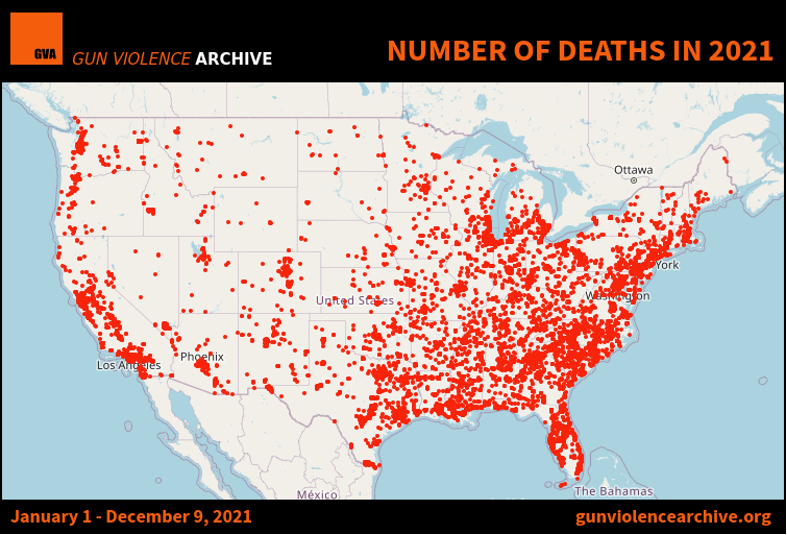
In contrast to those millions with a mental illness, there have been 657 mass shootings in 2021 as of December 9.12 Although that is 657 too many mass shootings, it is evident that a very small percentage (.0000438%) of those with a mental illness are going to turn into killers—and that’s if we swallow the notion that all the killers have a mental illness, which we absolutely shouldn’t. Perhaps they have no disorder at all but have been groomed with guns and are going through puberty.
If you asked me to replay my pubescent years for a billion dollars I would not do it. The Hell that is my mental illness in many ways pales in comparison to the emotional and mental roller-coaster puberty was. Not that I was in danger of committing violence, mind you. But I grew in a culture for which guns were simply not acceptable, and were, barring only a few exceptions, illegal. We didn’t (and don’t) have school shootings, or indeed any mass shootings.

Of course, the recent case that’s dredging all this up yet again is the school shooting in Michigan’s Oxford High school on November 30, 2021. The 15-year-old Ethan Crumbley has been charged as an adult with murder and terrorism.13
Famously now, a teacher found a drawing in his desk of someone being shot, blood splatter all over the page, and the chilling scribbled phrases, “blood everywhere” and “the voices won’t stop.” In a meeting hastily arranged between school officials and Crumbley’s parents, the boy argued that the drawing was for a video game, and that he wanted to pursue a career in game design.
No one should have believed this for a second. And I’m not sure the school officials did buy it. But the boys’ parents refused to take him home as asked. Stuffed into his backpack was the semiautomatic handgun that his parents had bought for him as an early Christmas present. Already the first wave of lawsuits has hit the school, including ones disingenuously aiming at teachers who, by all accounts, did absolutely everything they could that day.
More lives weren’t lost because the kids had already enacted active shooter drills. They didn’t have those when I went to school. Now elementary schools as well as middle and high schools practice for an armed incursion and kids wear bulletproof back-packs… except after a school shooting: Then they wear clear backpacks. It’s a good commentary on the times we live in. (As well as good commentary on how supremely unqualified these violence-normalizing Republicans are to serve our country in Congress, or anywhere else.)
But back to Crumbley: The school has argued that they weren’t certain of his intentions because he was “so calm” during the meeting. Even if Crumbley has a mental illness/disorder/glitch that includes delusions and intrusive voices, he can act calm! Those with a SMI who are high functioning would easily be able to explain away the drawing. You should hear how inventive I can be to avoid being involuntarily hospitalized. (It’s worked.)
Being able to disassociate from an illness-induced state to the point of acting perfectly rational and within all norms is not hard for some of us. You can be sure that the issue of whether or not Crumbley has any mental illness will take center stage soon. Although there’s nothing stopping him from being prosecuted either way. As long as he can stand trial, he will. Lehman and Smith, defense attorneys stated in a statement to NPR right before the arraignment:
While it’s human nature to want to find someone to blame or something to point to or something that gives us answers, the charges in this case are intended to make an example and send a message. The prosecution has very much cherry-picked and slanted specific facts to further their narrative to do that.14
I’m not sure that “making an example” out of a school shooter makes any sense whatsoever. Absolutely no one, mentally ill or otherwise, is going to spend time before shooting up a school weighing the punishment previous shooters received. We don’t yet know whether Crumbley has a mental illness, but you can be certain of one thing: we’ll hear a lot about mental health in lieu of meaningful change in gun control.
When a teacher told the parents Crumbley was searching for ammunition on his phone during class, his mother texted her son, “LOL I’m not mad at you…. You have to learn not to get caught.”15 The parents had taken their son to the range the week before the shooting. I do not say it lightly, and I say it again: Crumbley is a product of violence. And a significant part of that violence is fostered by the GOP and NRA.
It’s not like this in other countries! And we should pay attention to what other countries do because when we pull policy out of our rears based on knee-jerk reactions, it usually goes sideways for a large population of people.
Why do we as our country’s citizens accept these narratives that end up costing thousands of lives? Regardless, as I said, expect to hear a lot of politicians—all of them right-wing, talk about mental illness instead of reform. Yet another way in which PMI are marginalized—yoked up to a school shooter and tied together with violence.
Mr. and Mrs. Crumbley have also been arraigned, in the first attempt to hold parents at least partially accountable for their child’s evil actions. In this particular case such accusation seems to be warranted.
Gun deaths in 2021 (up to December 9)
Reuve and Welton said in 2008 that the stigma against PMI stems from their association with violence:
In society today, mental illness and violence are often seen as inextricably linked, creating a harsh stigma for patients and, at times, an uncomfortable environment for psychiatrists. The perception carries serious consequences for psychiatric patients in the form of further discrimination and a sense of isolation from society.16
The fear of school shootings is the number one cause of anxiety among Generation Z between 15-21, of whom 91% reported recently experiencing at least one clinical indicator of stress disorder17: “Current events are clearly stressful for everyone in the country, but young people are really feeling the impact of issues in the news, particularly those issues that may feel beyond their control.”18 One partial cause of the monumental anxiety? The media.
News coverage of mass shootings frequently emphasizes the perpetrator’s mental health, as mentioned. When coverage of a trial begins, the entire audience will hear mental illness is the sole reason behind the atrocity. Blurred into one are the how they did it and why they did it; all that emerges is a picture of illness-induced madness.19 Coverage is 24/7 on traditional and social media—a constant reinforcement of the stereotypes of PMI.

Is there anything that can be done? There is literature devoted to reducing stigma in nursing students—who are least likely to pursue a career in mental health out of all the fields in healthcare unless an intervention is made during their training.20 In one study, nursing students were required to assist in an acute psychiatric ward with close supervision and support. Students were apprehensive of and unenthusiastic about working in the ward, yet later said their actual experience was quite different from what they had imagined:
“I thought I was going to see a lot of restraining, a lot of violence; there was nothing like that…”[FG3]. “Yeah, what I thought is ‘we’ll be giving them drugs, voluntary or involuntarily’. But no, it’s not like that. Some of them can actually say no to their drugs” [FG2].21
When nursing students were asked where they received the information that had caused them to consider PMI as violent or frightening in the first place, they all said, “the media.”22
Studies have been performed on patients who were discharged from an acute mental health care facility to monitor them for violent tendencies. The subjects were not involved in violence at a rate greater than others who lived in their neighborhoods.23 It’s a complete myth that those with mental illnesses are violent. Although it’s a myth that has its supporters.
People with a SMI might act atypically, possibly loudly and unpredictably. I remember being at a Starbucks, and a homeless man who had psychological problems if not a diagnosable mental illness was kicked out of the sandwich shop next door. He started ranting loudly and walking erratically my way. He passed where I was sitting, and I immediately felt awful for him. I walked up to him, securing his attention without making eye contact. As soon as he started to say, “Get away from me!” I outstretched my arm to the side, offering him money. He calmed right down.
But he was suspicious at first. “Are you serious?” He asked. And my heart broke at the question. I nodded and returned to my latte. Honestly, was I giving the money to him because he needed it? Or I needed to not be triggered? When you grow up with a bipolar father there are many rocky times that have nothing to do with you really, but you experience the earthquakes nonetheless. I really don’t do well with ranting. I’d like to believe I’m all heart, but maybe the truth is it was a bit of both.
After Sandy Hook, there was a revival in the effort to enact gun control laws, some of you will recall. News coverage, operating as a mouthpiece for the White House, the NRA, and legislators on the state and federal level, increasingly intertwined mental illness with gun control.24 That pairing would sear its mind into every viewer and listener. The stigma against mental illness—particularly serious mental illness—is rife, and a significant source of prejudice originates through media.
Perhaps counter-narratives played through the same media could alleviate some of the stigma? Some literature on this subject explicitly uses framing theory. Essentially, framing theory suggests that the way something is presented to someone (called “the frame”) influences the choices that person makes about how to process the relevant information.
In 2018, researchers gave participants in a study either a negative frame to read: “People with a mental illness have a higher risk of self-destructive behavior, are generally unable to hold a job, and abuse the system by making others pay for their psychological help,” or the counter-frame “it is wrong to assume that they have a permanent higher risk to get addicted or to commit suicide.”25
The study showed that reframing was an effective way to influence attitudes. (Although the study may well have cause to use the specific wording, it’s worth remembering that these days a person does not commit suicide—they die by suicide. The wording is necessarily important as the layers of stigma are pealed back against serious mental illness and suicide.)

The power of reframing exists within narrative theory. In a healthcare setting, an application of this theory is used to help patients make sense of their diagnoses and assist them in taking control over their illnesses26: “Narratives are the stories we elaborate on in order to make meaning of our lives and to both guide and justify our actions.”27 In a situation involving mental illness, reframing can help reduce self-stigma.
It would seem targeting the segment of the population most likely to shift in belief pattern is a logical way to begin. According to Pew Research, “Generation Z—diverse and on track to be the most well-educated generation yet—is moving toward adulthood with a liberal set of attitudes and an openness to emerging social trends.”28
The point of narrative theory is to create understanding, not from demonstrating logic or through persuasive argument, but by telling stories. It would seem media would be a good vehicle for these narratives: “the communicator and the audience are equally active in co-constructing a shared story that makes sense to them by identifying together the ‘good reasons’ for that interpretation.”29
Public Service Announcement (PSAs) could be crafted in such a way as to tell a story that mediates new, shared meaning. The creative details of the PSAs are beyond the scope of this paper; suffice it to say, they would involve powerful images and verbal messaging designed to show that PMI should be accepted members of society—a narrative to write over the negative stereotypes in the viewer’s current narrative of life.
There is good reason to believe a media intervention would be successful. In 1980, researchers showed that college student’s perceptions of mental illness could be altered to the point of significant fear reduction just with a single, simple, educational seminar. The researchers further say, “If therapy is explained better as an ‘educational process’ rather than ‘treatment,’ therapists who teach clients to conceptualize in more psychologically constructive ways may assist clients in reducing their fear of loss of control, a desirable goal within psychotherapy.”30 Narrative therapy, by the way, is a school of therapy whose practitioners endeavor to help clients change their negative beliefs—like self-stigma—through a narrative process.
In general, mental illness by itself does not pose any increased risk of violence when appropriately treated. In fact, people with psychiatric disabilities are far more likely to be victims of violent crime than perpetrators thereof. Individuals suffering from schizophrenia, bipolar disorder, or psychosis are more likely to be attacked, raped, or mugged than members of the general population.31
From my own experience I have been on the receiving end of unwanted sexual advances since I was 13, and assaults since I was 17. I never learned how to protect myself, despite enrolling in self-defense classes and holding my own with an ice hockey goalie stick. As a result, not many years ago I was attacked by my neighbour’s gardener in the middle of the day.
I disassociate in critical moments like these, feeling nothing, mentally processing nothing except the words I can use to talk my way out of the situation. My greatest gift is my words, and I’ve talked my way out of some very shady and even dangerous circumstances. With every attack, however, my fear grows greater, my agoraphobia becomes more entrenched, and my trust in people erodes. It would be nice to “be tough,” but it’s not in my DNA or upbringing.
If a simple seminar can change minds like it did for those students, hopefully communication that is more media-rich will be even more effective. There is an additional psychological motivation for playing a PSA: the same media that mediated the stigmatization will be broadcasting or displaying the counter-narratives. Hopefully viewing a PSA on the same media that delivers the negative content will have a moderating effect.
Of importance, it’s not just the news that scares people. Who could enumerate all the movies featuring people who are mentally ill as scary and violent? Or the television shows that are based in a horror-themed sanatorium, designed to inspire a cheap thrill of terror when the violin strings are plucked over the entrance of a “psychopathic” patient? How about inducing compassion for the flesh and blood sufferers who were historically tortured inside them?
PMI are some of Steven King’s favorite villains for his novels: a fan club (Stephen King Wiki, n. d.)32 cites 26 movies featuring a PMI as a criminal or killer. Authors like Stephen King believe any type of person should be on the table for use in his novels, but that just means he has abdicated responsibility for the real-world actions to which his books and movies give inspiration.
No, I’m not saying that someone reads The Mist and becomes a supernatural bipolar killer, but if you’re not educated about bipolar disorder, you now see sufferers as evil, violent, and deranged criminals rather than marginalized people who lead very challenging lives.
In the television show of that title, the evil ghost mother explains that she was sectioned (aka committed) because when her daughter was a baby and cried she couldn’t go over to pick her up. I’m not sure this narrative has a place in a horror show. It is lifelike. And it is tragic. But the mom receives no Hollywood pity—just fear and hatred, as per design.

Stigmas are formed by society’s reinforcement of what people with mental illness should be like, and further shaped through media that depict PMI as dangerous and violent. In reality, we are a class of people who suffer immensely, both from illness and from the public. With the fingers pointed at media for causality, logic dictates that media be used for changing the narrative of PMI.
Although media are not the sole cause of stigma, they could possibly be employed to reduce it as they have certainly been a large part of the problem. A study involving a PSA would be a big undertaking, but could possibly help transform society in the long run. The psychological toll of the pandemic has not yet reached its peak, and action must be taken to secure the mental health of especially the younger members of our society.
Culturally, the US does not create many PSAs, preferring instead to air obscenely expensive paid advertisements for prescription drugs with lots of dangerous side effects that you really shouldn’t ask your doctor about. In contrast, the UK airs PSAs for everything from advertising Covid-19 support networks to promoting condom use.
Positive PSAs, with carefully crafted narratives perhaps targeted at Generation Z, could possibly help a generation that is so severely over-anxious. Perhaps that generation will lift some of the stigmatization against people with serious mental illness, allowing them to feel more accepted in society and live without self-stigma or perceived stigma.
The younger American generations are far more vocal about issues historically considered taboo. We now have “people who have their period” (rather than women) because some trans men have uteruses. I’ve read articles, seen clips on my computer—the trans community is out, proud, and determined to change the status quo—(and Republicans).
Surely if LGBTQ advocates can push important issues to the forefront of society’s awareness, there are advocates? If it’s any mental illness that isn’t considered clinically serious, like social anxiety or unipolar depression, there are, in fact, advocates. In fact, there is more support (and reduced stigma) for people with depression than ever before.
We have a long way to go on reducing stigma, especially against those who are most vulnerable to it, like people with schizophrenia spectrum disorder (SSD). It seems any gains will be undone immediately unless we can change the way media portray PMI. For that to happen, many more of us would need to want to change the status quo.
References
- https://doi: 10.2165/00023210-200620020-00002 (p. 99)
- https://doi.org/10.1016/S0924-9338(15)31066-X
- https://doi.org/10.1371/journal.pone.0224418
- https://doi.org/10.5130/portal.v11i1.3295; doi:10.1521/jscp.2006.25.8.875
- https://doi:10.1521/jscp.2006.25.8.875
- https://doi.org/10.1176/appi.ps.631011 (p. 953)
- Ibid.
- https://scholarship.shu.edu/cgi/viewcontent.cgi?article=1060&context=shlj (p. 69)
- https://doi: 10.1111/inm.12808 (Findings, para. 5)
- National Institute of Mental Health [NIMH], 2021
- https://www.psychiatrictimes.com/view/post-covid-stress-disorder-emerging-consequence-global-pandemic
- gunviolencearchive.org
- https://www.cnn.com/2021/12/01/us/michigan-deadly-shooting-terrorism-charge/index.html
- https://www.npr.org/2021/12/04/1061465160/michigan-school-shooting-parents-captured-oxford
- https://www.nytimes.com/2021/12/03/us/crumbley-parents-charged-michigan-shooting.html
- https://www.ncbi.nlm.nih.gov/pmc/articles/PMC2686644/
- www.apa.org/monitor/2019/01/gen-z
- Ibid. (p. 20)
- https://scholarship.shu.edu/cgi/viewcontent.cgi?article=1060&context=shlj
- https://doi: 10.1111/inm.12808; doi:10.3109/01612840.2014.935901
- Ibid. (p. 88)
- https://doi: 10.1111/inm.12808
- https://doi:10.1001/archpsyc.55.5.393
- https://scholarship.shu.edu/cgi/viewcontent.cgi?article=1060&context=shlj
- https://doi:10.1080/10810730.2018.1538272 (p. 287).
- https://www.google.com/books/edition/Theories_of_Human_Communication/3sQOMQAACAAJ?hl=en
- https://doi:10.1075/target.24.2.04har (p. 287)
- https://www.pewresearch.org/social-trends/2019/01/17/generation-z-looks-a-lot-like-millennials-on-key-social-and-political-issues
- https://www.google.com/books/edition/Theories_of_Human_Communication/3sQOMQAACAAJ?hl=en (p. 349.)
- https://doi.org/10.1002/1097-4679(198001)36:1<275::AID-JCLP2270360135>3.0.CO;2-5 (p. 276)
- https://scholarship.shu.edu/cgi/viewcontent.cgi?article=1060&context=shlj (p. 67)
- https://stephenking.fandom.com/wiki/Main_Page
Background Reading
Bethune, S. (2019). Gen Z more likely to report mental health concerns. Monitor on Psychology, 50(1), 20. https://www.apa.org/monitor/2019/01/gen-z
Chan, K. K., & Mak, W. W. (2015). The prevalence of stereotype self-concurrence and habitual self-stigma in a community sample of people with mental illness. European Psychiatry, 30(1), 1375. https://doi.org/10.1016/S0924-9338(15)31066-X
Corrigan, P. W., Watson, A. C., & Barr, L. (2006). The self-stigma of mental illness: Implications for self-esteem and self-efficacy. Journal of Social and Clinical Psychology, 25(8), 875–884. https://doi:10.1521/jscp.2006.25.8.875
Foster, K., Giandinoto, J. A., Furness, T., Blanco, A., Withers, E., & Alexander, L. (2021). ‘Anyone can have a mental illness’: A qualitative inquiry of pre-registration nursing students’ experiences of traditional mental health clinical placements. International Journal of Mental Health Nursing, 30(1), 83–92. https://doi: 10.1111/inm.12808
Göpfert, N. C., Conrad von Heydendorff, S., Dreßing, H., & Bailer, J. (2019). Applying Corrigan’s progressive model of self-stigma to people with depression. PloS one, 14(10), 1–14. https://doi.org/10.1371/journal.pone.0224418
Gun Violence Archive (2021, April 26). Gun Violence Archive 2021. Retrieved April 26, 2021, from https://www.gunviolencearchive.org/
Hunter, L., Weber, T., Shattell, M., & Harris, B. A. (2015). Nursing students’ attitudes about psychiatric mental health nursing, Issues in Mental Health Nursing, 36(1), 29– 34, https://doi:10.3109/01612840.2014.935901
Morrison, J. K., & Teta, D. C. (1980). Reducing students’ fears of mental illness by means of seminar-induced belief change. Clinical Psychology, 36(1), 275–376. https://doi.org/10.1002/1097-4679(198001)36:1<275::AID-JCLP2270360135>3.0.CO;2-5
National Institute of Mental Health. (2021). Mental illness. Retrieved April 26, 2021, from https://www.nimh.nih.gov/health/statistics/mental-illness.shtml#:~:text=Mental%20illnesses%20are%20common%20in,mild%20to%20moderate%20to%20severe
Parker, K., Graf, N., & Igielnik, R. (2019, January 17). Generation Z looks a lot like millennials on key social and political Issues. Pew Research Center, https://www.pewresearch.org/social-trends/2019/01/17/generation-z-looks-a-lot-like-millennials-on-key-social-and-political-issues/
Rössler W. (2016). The stigma of mental disorders: A millennia-long history of social exclusion and prejudices. EMBO reports, 17(9), 1250–1253. https://doi.org/10.15252/embr.201643041
Steadman, H. J., Mulvey, E. P., & Monahan, J. (1998). Violence by people discharged from acute psychiatric impatient facilities and by others in the same neighborhoods. Archives of General Psychiatry, 55(5), 393–401. https://doi:10.1001/archpsyc.55.5.393
Stephen King Wiki. (n.d.). Characters with mental illness. Retrieved April 27, 2021, from https://stephenking.fandom.com/wiki/Category:Characters_with_mental_illness
Teh, J., King, D., Watson, B., & Liu, S. (2014). Self-stigma, perceived stigma, and help-seeking communication in people with mental illness. Journal of Multidisciplinary International Studies, 11(1), 1–18. https://doi.org/10.5130/portal.v11i1.3295
Tucker, P., & Czapla, C. S. (2021). Post-COVID Stress Disorder: Another emerging consequence of the global pandemic. Psychiatric Times, 38(1), n.p. https://www.psychiatrictimes.com/view/post-covid-stress-disorder-emerging-consequence-global-pandemic
Vyncke, B., & van Gorp, B. (2018). An experimental examination of the effectiveness of framing strategies to reduce mental health stigma, Journal of Health Communication, 23(10–11), 899–908, https://doi:10.1080/10810730.2018.1538272
Wiehl, T. (2014). The presumption of dangerousness: How New York’s Safe Act reflects our irrational fear of mental illness. Seton Hall Legislative Journal, 38(1), 35–69. https://scholarship.shu.edu/cgi/viewcontent.cgi?article=1060&context=shlj
I was very pleased to find this site. I wanted to thank you for your time for this particularly wonderful read!! I definitely savored every little bit of it and i also have you book-marked to see new stuff in your site.
https://shorturl.fm/iQHr7
https://shorturl.fm/u1Tfk
https://shorturl.fm/DSGOV
https://shorturl.fm/P91fm
https://shorturl.fm/qMKmE
Been playing around on codwin lately. It’s got some decent options if you’re looking to test your luck. Give codwin a shot and see if you can hit that jackpot!
Okay, Happybingo is seriously cheerful! If you’re into bingo, this might be your happy place. Worth a look for a bit of fun at happybingo.
Quick check-in on ilottery – it’s where I grab my online lottery tickets. Easy and convenient I tell ya. See for yourself at ilottery.
https://shorturl.fm/9mPlZ
https://shorturl.fm/q95yb
https://shorturl.fm/I67BR
https://shorturl.fm/KbObV
https://shorturl.fm/zzAZQ
https://shorturl.fm/x9ns1
https://shorturl.fm/MKaqC
Heard about some sweet deals with an indibet promotion code. Anyone know where to find the best one? Need that extra boost! Find out more indibet promotion code
Jili5 is legit! Been playing a bit and having some decent luck. Graphics are solid. Give it a spin, you might like it. Go check jili5
Rami91? Hmm, I’m curious. Saw some ads. Anyone actually win anything decent on there? Tell me your experience about rami91
https://shorturl.fm/3wOut
Новинки музыки 2026 скачать бесплатно https://shorturl.fm/pj0rJ
https://shorturl.fm/sZ7oS
https://shorturl.fm/y99GZ
https://shorturl.fm/bIsSt
Thinking about trying full88vnz. Anyone have any experience with it? Let me know if it’s legit before I dive in! More info can be found at full88vnz
Is hindubetgame any good? I’m always looking for new options and this one popped up. Looking for honest opinions! Give it a look yourself at hindubetgame
Need to log in to cricbet999login but can’t remember my details! Argh! Seriously though, is it worth the hassle? Get logged in at cricbet999login
https://shorturl.fm/5Ugot
Grabbed the x7777appdownload app. Easy to install, and actually a decent selection of games. Might just be my new go-to app and all. Download is right here: x7777appdownload
Another solid link for M888 is linkm888. I use it when the main site’s being slow. Keeps me in the action. Check it out: linkm888
W88clublogin is the quickest route to your W88 account. No need to memorize long URLs. Just bookmark this one. Easy access: w88clublogin